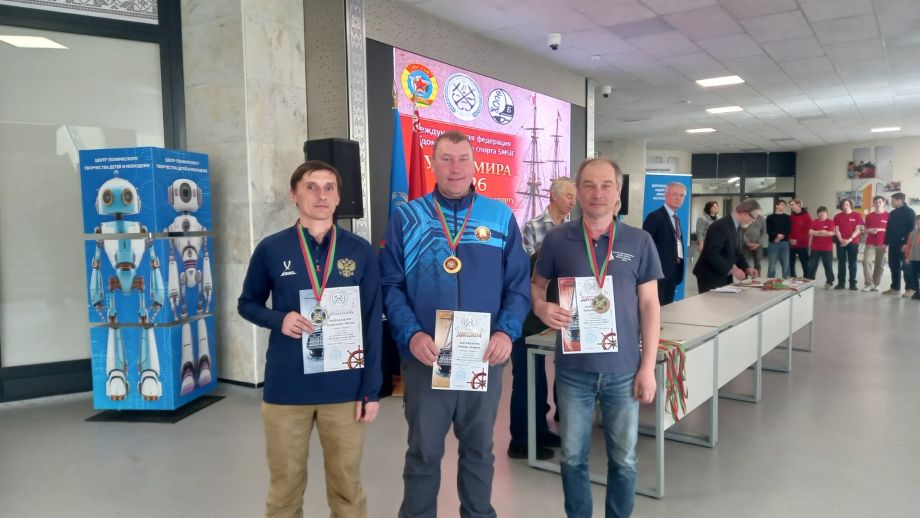
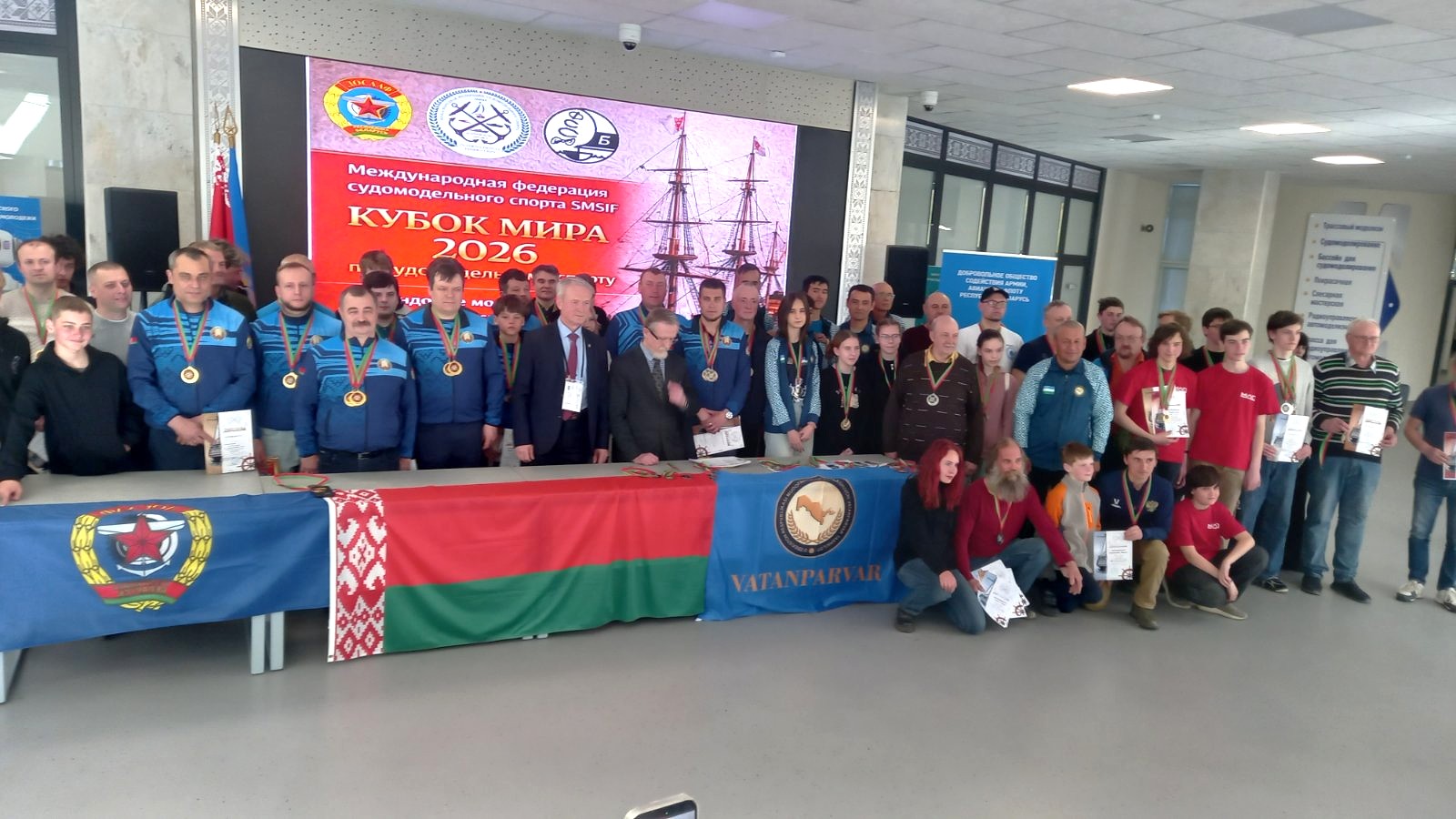
The second World Shipmodeling Sport Cup finished on April, 26. “Minskaya Vesna-2026”, just as previously, took place at two venues. Competitors were able to undergo static assessment inside the spacious and convenient “Center for Technical Creativity for Children and Youth” thanks to facilitation from the Mingorispolkom Education Committee and administration of “Minsk Municipal Palace for Children and Youth” Educational Institution…
► "Belarus-1" TV Channel – news report
► "РТР-Belarus" TV Channel - news report
Just to mention, the Center itself opened quite recently, in 2025, and can be proud of its excellently equipped offices and laboratories.
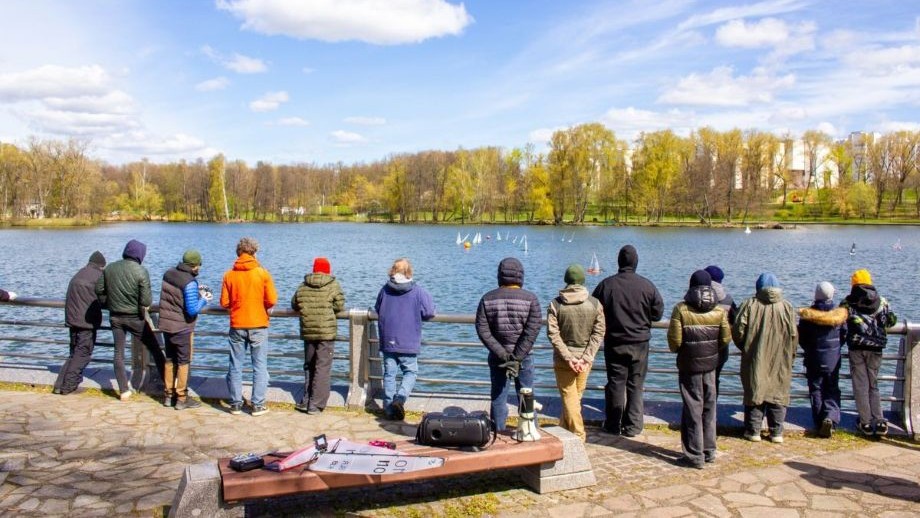
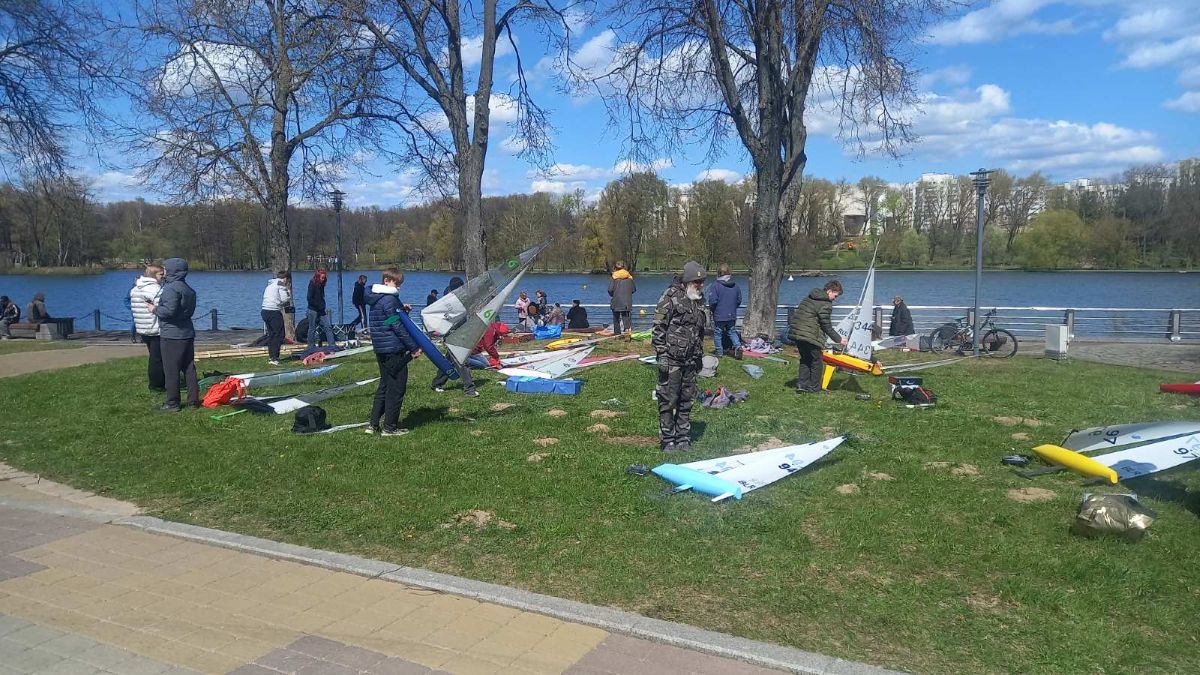
The total number of models registered for the Cup ran close to 260, around 150 of those were static ones. The static scaled models were generously allocated a separate hall in the Center. This step allowed to accommodate all the models while providing their fine overview for guests and judges, to set up working places for the judges’ team and the secretaries. As for the yachts, this year competitors registered for 3 classes (RG65, F5-E, F5-M) as compared to only two classes last year! Their races were held at Komsomolskoye Lake right in the center of Minsk.
Thanks to the impressive number of participants from 11 countries, all classes of static models were present at the competition, including a new С-8С demonstration class (dioramas, cross-sections and series of models from wooden and composite kits). Judges and spectators could see both familiar models and new ones, quite striking and ready to fight for prizes. Such classes as С-2 (models of ships with mechanical propulsion), С-6А (plastic kit models) and С-7А (paper and cardboard kit models), С-8А (sailing ships models from combined kits) traditionally gathered most competitors. Interestingly, several very well-executed models competed in not so “well-populated” classes.
Thus, among C-1 Class models (sailing ships) the best result was achieved by medieval “Witsen” pinas once belonging to the East-India Company. The model was constructed by Sergey Upolnikov (Belarus) and received a silver medal due to the relative simplicity of the prototype ship. “Nastoychiviy” destroyer by Mikhail Safrygin (Russia) won 97.00 points and a gold medal in С-2 Class.
As for С-3В Class (hull models, cross-sections and models with their sheathing partially removed), here everyone’s attention was riveted to Eduard Vorobyev’s new models. The competitor comes from Volgograd (Russia) and his works were for the first time presented at Tsemes Bay Cup-2025. This year, at “Minskaya Vesna-2026” his “HMS Blandford” frigate was completed with more sails to its greater advantage. The model well deserved its 97.67 points and a gold medal due to meticulously implemented details and rigging together with the fine and highly artistic execution approach to wood carving. And “Cignet” British frigate, also from Eduard Vorobyev, won a silver medal.
All С-4 subclasses (miniature models under 1:250) were united as one group. This group does not comprise as many participants as other classes since constructing even a 1:250 sailing ship model is a challenging task, not to mention smaller models such as Oleg Khotko’s “Svirepiy” patrol boat. Alexey Kutovenko’s models defined the atmosphere of the whole class as this modeler has a certain flair for medieval carracks.
Another class which rarely collects the required number of participants is C-5 (models in bottles); this time all the works presented at the World Cup came from Uzbekistan. It is worth mentioning that all these models were filled in to the utmost (one of the evaluation criteria is exactly to what extent the bottle is occupied by the ship). The complexity of mounting the model was also amazing: the hulls of the ships had been assembled inside the bottle in 4 parts and only following their completion, other separate details, rigging, sails and cordage were mounted as well. Marat Khakimzanov’s “Santa Maria” (Christopher Columbus’ caravel) won the top number of points (97.33) and a gold medal.
Unlike the previously described classes, С-6А Class has traditionally been well-represented, and this time the competition was also tough. The judges had to evaluate nearly 30 models, among which the best were awarded with gold medals:
- “Kongo” battleship, Oleg Khotko (Belarus);
- “North Caroline” battleship, Alexey Kalmykov (Belarus);
- “Koreyets” gunboat, Sergey Kostyuk (Russia);
- “Varyag” cruiser, Sergey Kostyuk (Russia);
- IJN “Tone” cruiser, Alexander Demidyuk (Belarus);
- “Kuznetsov” aircraft carrier, Matvey Tumar (Belarus);
- “Richelieu” battleship, Vitaliy Shakhno (Belarus).
The С-6В Class (plastic models, scale under 1:500) saw a genuine (sports!) fight among WWII battleships all vying for victory. One can dwell a little longer on С-6С Class (series of models and plastic kit dioramas). Here, two quite different dioramas captured the attention with their scenarios, high-quality execution and refinement level. The first diorama, a new work from Ivan Kinyev (Russia) is called “Embraced by the dock” and represents a fragment of the American Project ABSD floating dock together with “Gato” type submarine (1945). Another outstanding diorama belongs to Anton Khoteev (Belarus) – “Convoy PQ-18 (1942)”. These two dioramas were justly awarded 99.00 points and gold medals. Valentin Karengin’s “Kriegsmarinen” (a 3-model composition of the German navy) fell only 1 point behind. Besides, several intriguing series of submarine models from Belarus and Russia competed in this class (С-6С).
As for С-7А Class (paper kit models, scale up to 1:250), I. Yaroshenko’s model of “Admiral Hipper” cruiser (Belarus) was a definite leader. Nevertheless, “Tsesarevich” armoured cruiser and “Prinz Eugen” pocket-size battleship from Alexey Ryzhov (Russia) left other competitors far behind due to their thoroughly refined details, richness and complexity of the models’ prototypes. One should only look at the hull shape of “Tsesarevich” to understand the kind of challenges one has to meet while creating a paper model of this ship! Unfortunately, these two models lost several points as they breached SMSIF Rules for C Classes, i.e. the modeler used double sheathing while constructing the hulls (and that is not allowed).
The leader in С-7С Class was Ivan Vasko (Brest, Belarus) who untied all his previous models into a single exposition, “WWII British Fleet” – and this proved to be the right decision as the exposition was awarded with 99.00 points and a gold medal at the Cup. In С-8А Class, “Polotsk” schooner (Alexey Busel) and “Foenix” schooner (Vitaliy Chernushevich) received practically the same number of points – 96.00 and 95.67 correspondingly. Both models stand out thanks to their meticulous execution, neat and careful wiring of rigging.
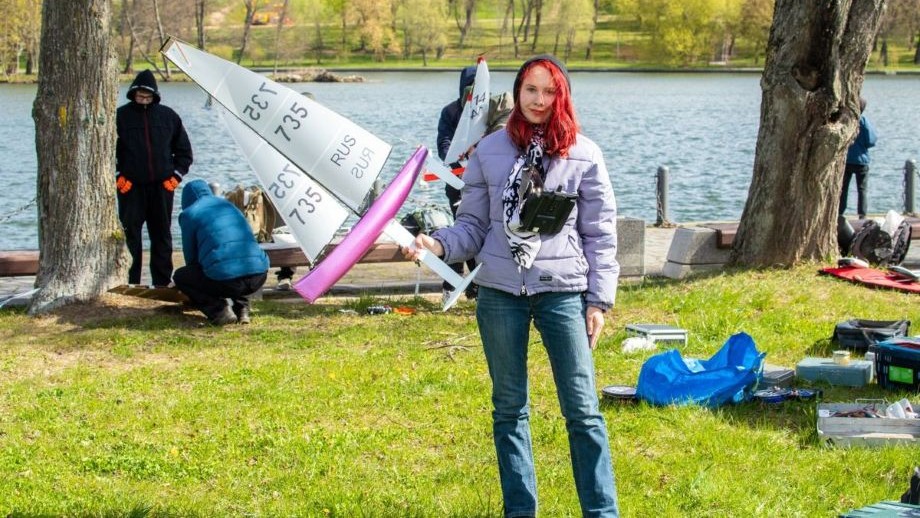
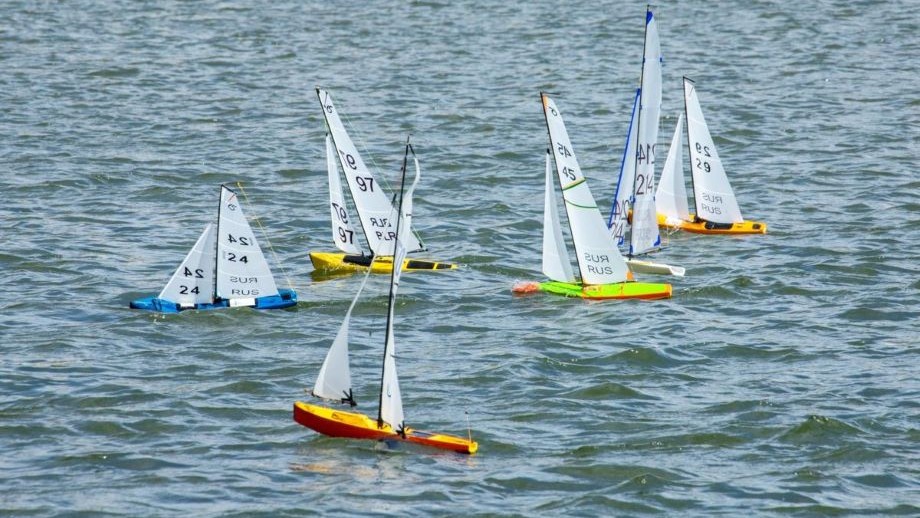
Yacht classes turned out to be quite popular among the competitors, for instance, 37 modelers participated in RG65 Class, and F5-E saw a “full house” – 43 models! Windy weather added thrill to the competition, making the races exciting and dynamic. Some casualties were unavoidable under these conditions – an RG65 Class model from Belarus started leaking, got too much water inside and finally sank. The last day of the competition was a real ordeal even for the most experienced and staunch modelers – they had to compete in gale wind and snowfall. As a result, only 21 out of 29 participants risked going to the starts that day. Still, the race had to be wrapped up right after the first 6 turns: nearly all the models were heavily damaged, with broken masts, torn sails and ratlines.
To sum up, Dmitriy Koipish (Minsk, Belarus) was the winner among senior competitors in all three yacht classes, silver and gold medals went to Russian competitors. The best junior racers were again Russian Daniil Kuzmin (RG65 and F5-M Classes) and Tikhon Palkin (F5-E Class).
Our thanks to all participants and judges of World Sipmodeling Sport Cup-2026! We wish everyone new and bright achievements at the international starts!
Dmitriy Kalmykov, Chief Judge of “Minskaya Vesna-2026” World Cup
https://shipmodelsport.org/eng/index.php/118-minskaya-vesna-2026-world-cup-competition-results?layout=default&print=1&tmpl=component#sigFreeId80e5735130